


 +86 152 6060 5085
 English
 русский
 español
 português
 العربية
 Polski
- Home
- Products
- News
- Blog
- Customer Cases
- About Us
- Contact Us
Hot Products
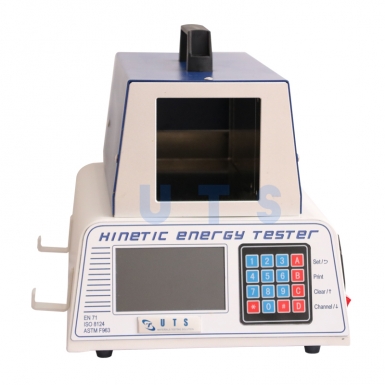
T011 Kinetic Energy Tester is used to test the maximum energy produced from projectile toy shoot bullets or launched bows, so as to evaluate ejection articles will cause injury for children or not.
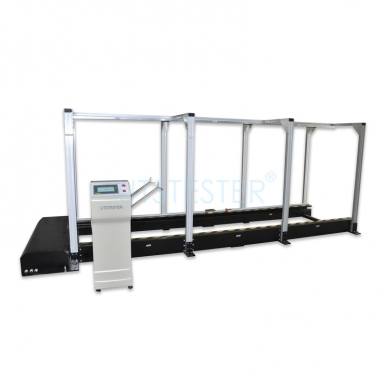
T012 Dynamic Strength & 2m/s Tester is used test dynamic strength for wheeled ride-on toys. Simulate children wheeled ride-on toys vertically crush the inelastic step 50 x 50 mm at the stable speed of 2m/s±0.2/s, and then check the damage degree. This device can be used for children ride-on toys, such as children tricycle, toy bikes, scooters, etc.
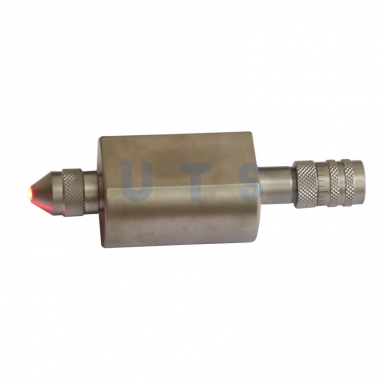
Sharp point tester is to determine whether accessible sharp points on child-related products are likely to cause injury. If the accessible sharp point penetrates a specified depth into the small rectangular opening of the tester, the LED is illuminated to indicate that the point is unacceptably sharp.
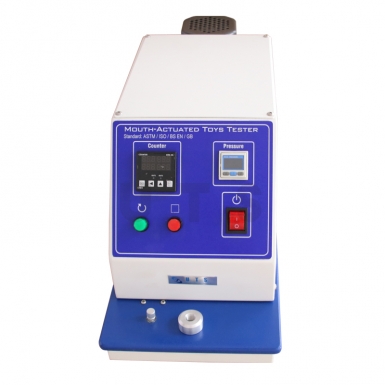
Used to test the safety of the Mouth-Actuated Toys, such as whistles with a ball, the sounders with a reed and other toys. Load the mouth-actuated projectile toy with the intended projectile and apply a pressure of 13,8 kPa ± 5 % in the direction of the mouthpiece for 5 s. Carry out the test 10 times in total.
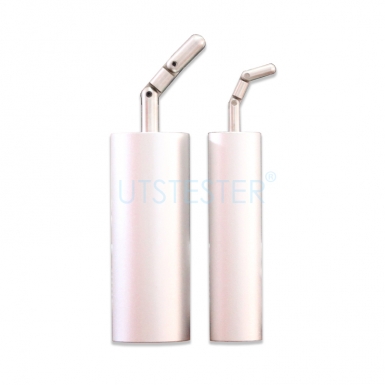
Accessibility Probe is used to assess the surface or components (points and surface of toys) of toys is likely to be touched and lead to hazardous. If the probe contacts the part or component, the part or component is considered to be accessible. Therefore, to do related tests based on standards to decrease hazards for children. This tools are including 2 parts: Probe A and Probe B. An accessible point for a toy or article intended for children 3 years of age or less is one that can be contacted by any portion forward of the collar of the accessibility probe designated as Probe A . An accessible point for a toy or article intended for children over 3 years of age is one that can be contacted by any portion forward of the collar of the accessibility probe designated as Probe B . An accessible point for a toy or article intended for children of ages spanning both age groups is one that can be contacted by any portion forward of the collar of either Probe A or B.
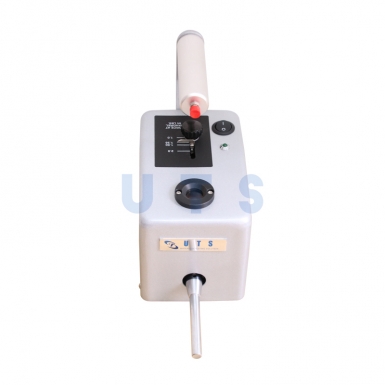
T001 Sharp edge tester is used to determine whether the accessible edges on child-related products are likely to cause potential risk of injury after normal use and reasonable abuse. Those child-related products include metal or glass edges on toys and other articles intended for use by children under 8 years of age.
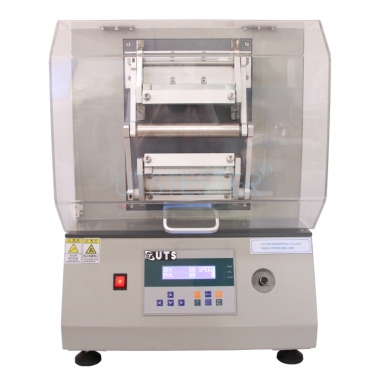
H018 Whole Sole Flexing Machine, to measure the material's resistance to incision elongation(cut growth) during repeated flexing, especially for outsoles of protective footwear, including soles. The machine has three vertical or horizontal stations available for customized and is easy to operate. Loading, unloading and measurements are also much easier to carry out with the workstations provided. The sample flexes at speed of 140 times per minute, and the exact number is recorded in a counter that has been preset to the required number of flexing. A fixture can be used to position the steel chisel, which can be used to support the sample after the initial chipping. All mobile parts that need access are fully protected with a fully interlocked security cover to ensure that the machine complies with the latest security regulations. A manual device can be used to measure the hardness of the outer bottom and check whether the outer bottom must be twisted in accordance with EN ISO 20344. UTS also provide a version of this machine for testing at low temperatures allowing tests to be conducted down to -20°C.
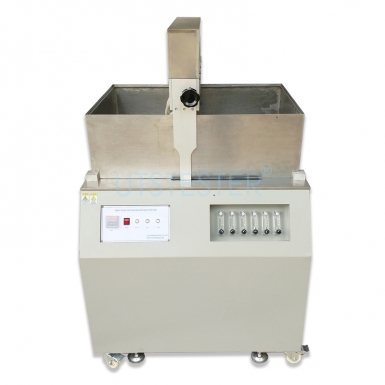
To determine the waterproofness property for finished shoes. Within the specified depth of water, whole shoe will be mechanically brushed by rotary wet brush, so as to measure the water penetration property for finished shoe.
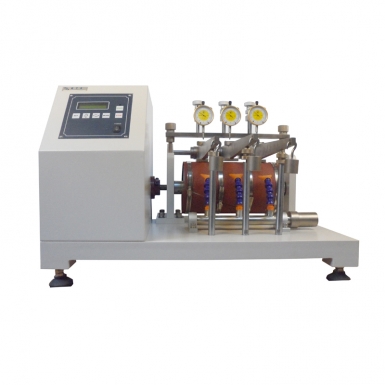
To determine the abrasion resistance property for rubber or other compounds, sole and heel materials which are not less than 2.54mm in thickness. This machine has memory function so that users can set the number of tests by themselves. The current records will be kept not to change even if power failure or stop occurs. It also can be connected to a cleaner for easy cleaning.
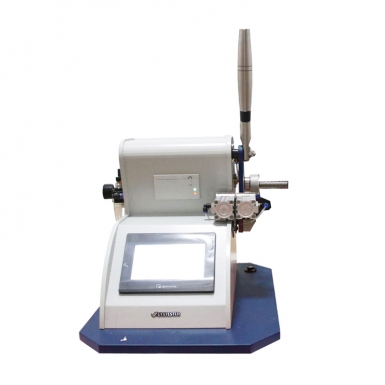
To determine the tearing resistance strength (Elmendorf method) for various textiles. Also available for thick paper, plastic cloth and electrical insulating tapes. Three interchangeable pendulums ranging from 16,000 to 128,000 Millinewtons (mN) can be selected separately for multiple test method compliance.
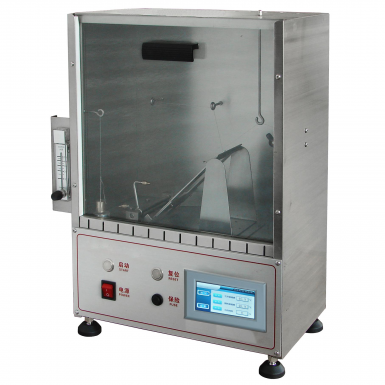
To determine textile damaged area and length at 45 degree condition and the times of touching flame when textile is melted to specified length after heated at 45 degree condition. Stainless steel test cabinet with glass observation panel provided with automatic timing of flame spread in 0.1 second increments from ignition. Automatic or manual flame impingement for 1,5 or 20 seconds.
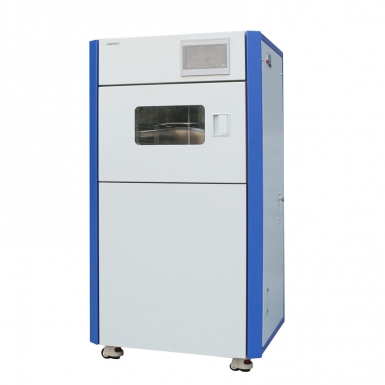
To determine water vapor permeability (waterproofing and moisture-penetration performances) for various fabrics (including moisture permeable coated fabrics) and Non-woven fabric for garment usage including bat wool, space cotton, etc.
Latest news

Recently, the 2026 EXINTEX International Textile Exhibition in Mexico successfully concluded at the Puebla International Convention and Exhibition Center. As Mexico’s largest and one of Latin America’...

UTSTESTER Notice: National Day Holiday Arrangement Dear valued customers and partners, We would like to inform you of our National Day holiday schedule. Our office will be closed from Oct 1 to Oct 7, ...

Recently, UTSTESTER completed the factory acceptance testing and loading of a batch of textile testing instruments. The equipment has been officially shipped to the customer’s designated location and ...
2019-11-30
Overview
This tester is suitable for testing the elongation of woven and knitted fabrics.
Test Principle
The two ends of the sample are evenly clamped in the two clamps before and after the instrument, and a certain distance is maintained. A certain tension force is applied to the moving clamp for a certain period of time. The elongation of the sample is calculated by the distance before and after the sample is stretched.
Standards
BS 4294
Operation
1.Environment:The atmosphere was tested as specified in BS 1051, with a temperature of 20±2oC '65±2% humidity.
2.Sample preparation:When taking the sample, take the sample plate 100mm from the edge.
3.Preparation of knitted fabric samples:When taking the sample, there should be no creases and defects. Take 5 pieces of the template with the size of 75mm× 85mm vertically and horizontally, then put them in the standard atmosphere to reduce the humidity for 24 hours, and then carry out the test.
4.Preparation of woven fabric samples:When taking the woven fabric, there should be no creases or defects in the sample, and 5 pieces should be taken vertically and horizontally with the template size of 75mm×215mm.
5.1 instruments and devices
1. Remove the weight from the box
2. Place the instrument with one end of the weight toward the edge of the table.So that the rope on the instrument smoothly through the pulley, convenient to hoist the weight.
5.2 testing procedures for knitted fabrics
1. According to the instrument installation described in 3.1, ensure that the rope is free to hang the weight.
2. Turn the handle clockwise until it stops turning.
3. Attach a 3Kg weight to the end of the rope.
4. Load the knitted fabric, then tighten the fixture, record the length before stretching, and slowly turn the handle counterclockwise so that the weight moves freely downward until the woven fabric stops stretching.
5. After 10 seconds of testing, record the extension degree on the scale.
6. Then remove the weight and turn the handle clockwise until it stops turning.
7. Go to the sample and measure the length tested.
8. Then proceed to the next test
9. Calculate the stretch rate and recovery rate of knitted fabrics
10. Determine the result and take its average value.
When testing, if the fabric shows slip, the test result is invalid.
5.3 test procedures for woven fabrics
1. According to the instrument installation described in 3.1, ensure that the rope is hanging the weight freely. First turn the handle clockwise until it stops turning.
2. Attach two 3Kg weights to the end of the rope.
3. Load the woven fabric, then tighten the fixture and record the length before stretching. Slowly turn the handle counterclockwise so that the weight moves freely downward until the woven fabric stops stretching.
4. After 10 seconds of testing, record the extension degree on the scale.
5. Then remove the weight and turn the handle clockwise until it stops turning.
6. Go to the sample and measure the length tested.
7. Then proceed to the next test
8. Calculate the stretch rate and recovery rate of knitted fabrics
9. Determine the result and take its average value.
When testing, if the fabric shows slip, the test result is invalid.

Email: hello@utstesters.com
Direct: + 86 152 6060 5085
Tel: +86-596-7686689
Web: www.utstesters.com
Previous article :
Study on the properties of hygroscopic quick-drying fabricsNext article :
Comparison of testing methods for color fastness to washing of textiles
Room 312, Block D, Jiayuan Garden, No.2 Zhongfa Road, Zhangzhou City, Fujian Province, China

+86 152 6060 5085

+86 596 7686689


 hello@utstesters.com
 hello@utstesters.com
 +86 152 6060 5085
 +8615260605085